My selection of travel and history books inspired by drinking culture and drinks.
Following on from the previous foodie edition last season, this instalment of Armchair Travel is heading to the bar and ordering a cocktail, inspired by books about drinking cultures around the world and by travellers discovering the world through the bottom of a glass. So read on for a selection of drink-themed travel books and some stories inspired by alcohol-fuelled adventures. There are also a couple of non-alcoholic options on the menu too.
Here are 10 of my favourite books inspired by drink and travel.
My favourite travel books with a foodie flavour to inspire some culinary adventures.
Are you feeling hungry? This edition of Armchair Travel is leaving the sofa and heading through to the kitchen*, inspired by books by cooks and other hungry travellers discovering and sharing food cultures from around the globe. So read on for a mouth-watering selection of food-themed travel books and cookbooks filled with stories.
*then returning to the sofa after rifling through the fridge for snacks.
Here are 10 of my favourite books inspired by food and travel.
This is my selection of the most interesting and inspiring books about paddling adventures around the world.
This edition of Armchair Travel takes to the water in a selection of small craft, in canoes, kayaks and skiffs to explore the world from water level. These accounts of expeditions in small boats are tales of individual adventure on the water, but also embrace the pace of paddle-powered slow travel allowing the history and maritime culture of the regions travelled to unfold for the voyagers.
So whether you’re looking to find motivation to try a new activity, or you’re more than comfortable exploring the world from the waterline, read on for inspiration for making a paddling adventure of your own, or enjoy the vicarious undertakings of seasoned paddlers.
These are some of my favourite classic travel books.
In this edition of Armchair Travel, I’ve curated a collection of some of the true classics of travel writing. The beauty of many of these travelogues is that they take us back to lands which no longer exist.
This is a selection of notable titles by some of the best-known names in the genre, many of which have inspired later writers and travellers. It includes well-known works seeded by mountaineering and polar expeditions, journals of travels in unusual circumstances and situations, and wry looks at more familiar places. It should be recognised that some of the content of the books listed and the ideas expressed within have aged much better than others.
Read on to dive into the inspiration that has fuelled generations of travellers, ideas planning a travel adventure, or to travel vicariously in space and time without leaving the sofa.
A selection of my favourite books which dive into the history and culture of the Pacific Islands.
Armchair Travel this season brings you my favourite books which explore the fascinating cultures of the islands and archipelagos of the Pacific Ocean. Included in the selection are histories and ethnographies, travelogues and tales of adventure which will deepen your knowledge and understanding of the region. I’d love to know if you’ve read any of these books, and if you have any recommendations for me, especially any fiction by Pasifika writers. Leave me a message in the comments below.
But first, read on to find a wee bit of tropical island inspiration for planning your next travel adventure, or set sail on a Pacific voyage of discovery without leaving the sofa.
The Falkland Islands are an archipelago of seven hundred or so low, rocky islands which look like they’ve been flung out into the South Atlantic Ocean by the hooked tip of South America. Lying a few hundred kilometres from the coast of Argentina, a troubled history means they look further afield for their closest connections; up the length of the Atlantic to the British Isles, 9,000km (5,600 miles) to the north. The islands are an outpost of Britishness, and a gateway to Antarctica, South Georgia, and the wild Southern Ocean. There’s really nowhere quite like the Falkland Islands.
These small islands aren’t widely known outside certain spheres of interest, making them a destination for curious and intrepid travellers to explore. They’re not easy to travel to, nor particularly affordable, filing them in a ‘once-in-a-lifetime’ trip category for most who visit. Planning and preparation are key to making the most of your trip, so read on to learn more in my guide to visiting the Falkland Islands.
In this guide for travellers, you’ll find the information needed for planning a visit to the Falkland Islands, including the best things to do, with options for different seasons, background on the history and ecology of the islands, and detailed travel information. If you can’t find what you need to know about visiting the Falkland Islands, post your question in the comments, and I’ll do my best to answer it and update this post!
A selection of my favourite books with a desert setting.
This instalment of Armchair Travel brings you a selection of the best reads that capture the arresting beauty of arid landscapes and the unique challenges for those who live in or travel through them. Including riveting accounts of adventures, classic travelogues, and fictional works that bring deserts to life, there’s something for all interests.
Read on to find inspiration for planning your next travel adventure, or just explore the desert sands without leaving the comfort of home.
Starting my day with a coffee is really a non-negotiable, and where possible it has to be freshly-brewed real coffee. When I’m backpacking I enjoy taking my time over a good coffee in the morning. It gives me the opportunity to spend a few moments preparing for the day ahead, going over the route for the day, assessing the weather conditions, and reflecting on how things have gone the day before. It’s a wee bit of time for appreciating the place I’d spent the night, and a little bit of luxury to keep morale going when the weather looks grim, or there’s a tough day in the schedule.
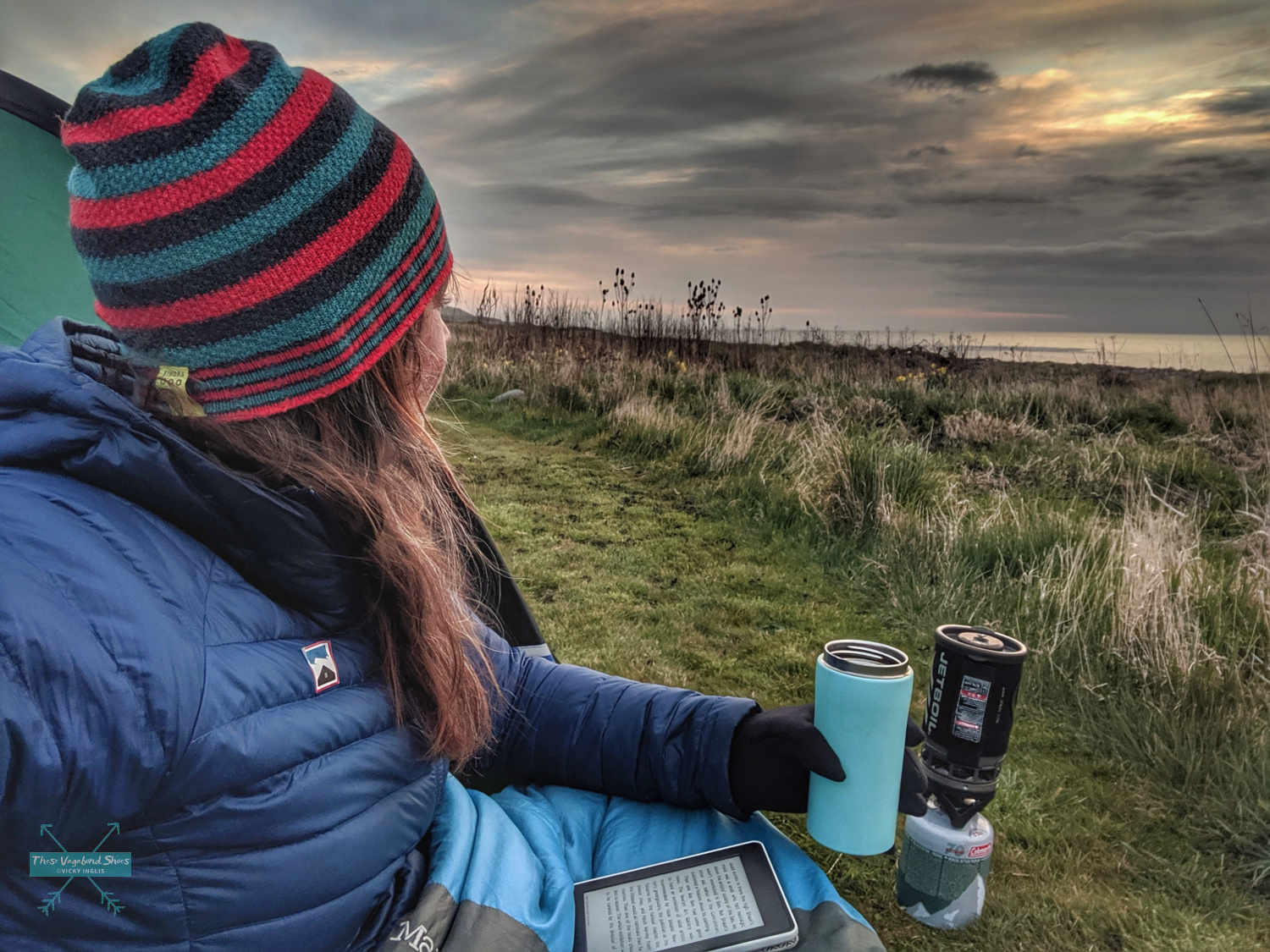
Waking up to a freshly brewed coffee on a winter camp by the coast
What am I looking for in a travel coffee maker for backpacking trips? It should be simple to use and easy to clean afterwards. It should be lightweight and small enough to pack into my travel bags, and robust enough to handle being stuffed into a rucksack. And the coffee has to taste good.
How I tested the Aeropress Go
I borrowed an Aeropress Go from my friend Josh to make a round of coffees for our group as we travelled back from South Georgia to the Falkland Islands on a Royal Navy ship, and was so impressed that I ordered one for myself once I got back home. When it arrived, I tried it out immediately in my kitchen and it quickly became part of my morning routine.
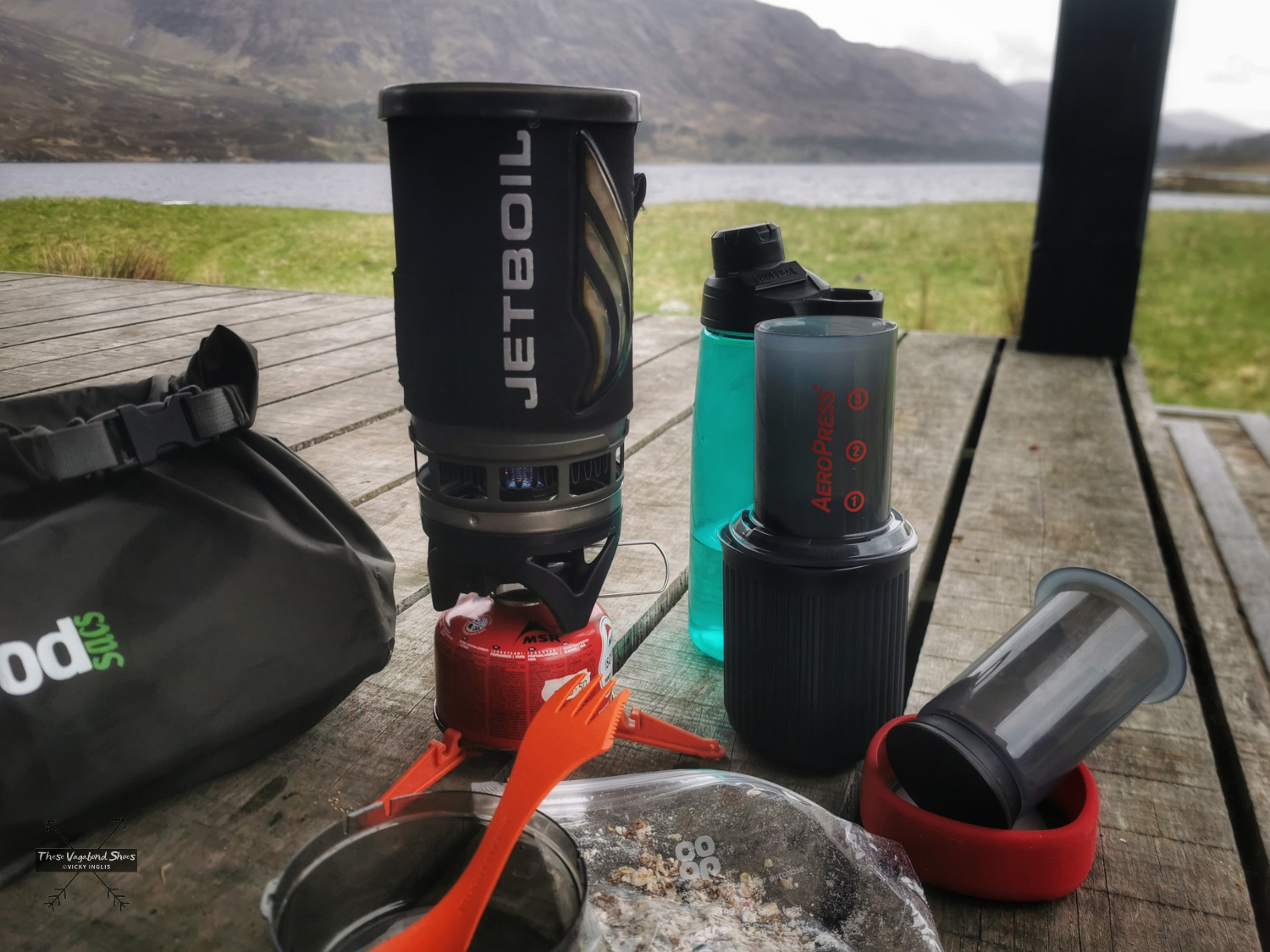
I took it with me on a two-night wild camping trip, a shakedown for taking part in the TGO Challenge, a self-sufficient coast-to-coast crossing of Scotland in May 2022, and kept it in my kit for the event. My TGO route on this occasion took 13 days to complete, walking between 25 and 30km a day, with one rest and resupply day scheduled around the halfway point. I carried all my equipment, including a Jetboil Flash 2.0 to heat water for hot drinks and prepare dehydrated meals.
Breakfast and a brew before walking the length of Loch Affric on the Affric Kintail Way.
For most of the TGO Challenge in 2022, I camped overnight in locations remote from local shops, cafés or pubs, so there was no alternative other than to brew my own coffee in the morning before starting to walk if I wanted it.
Product Description
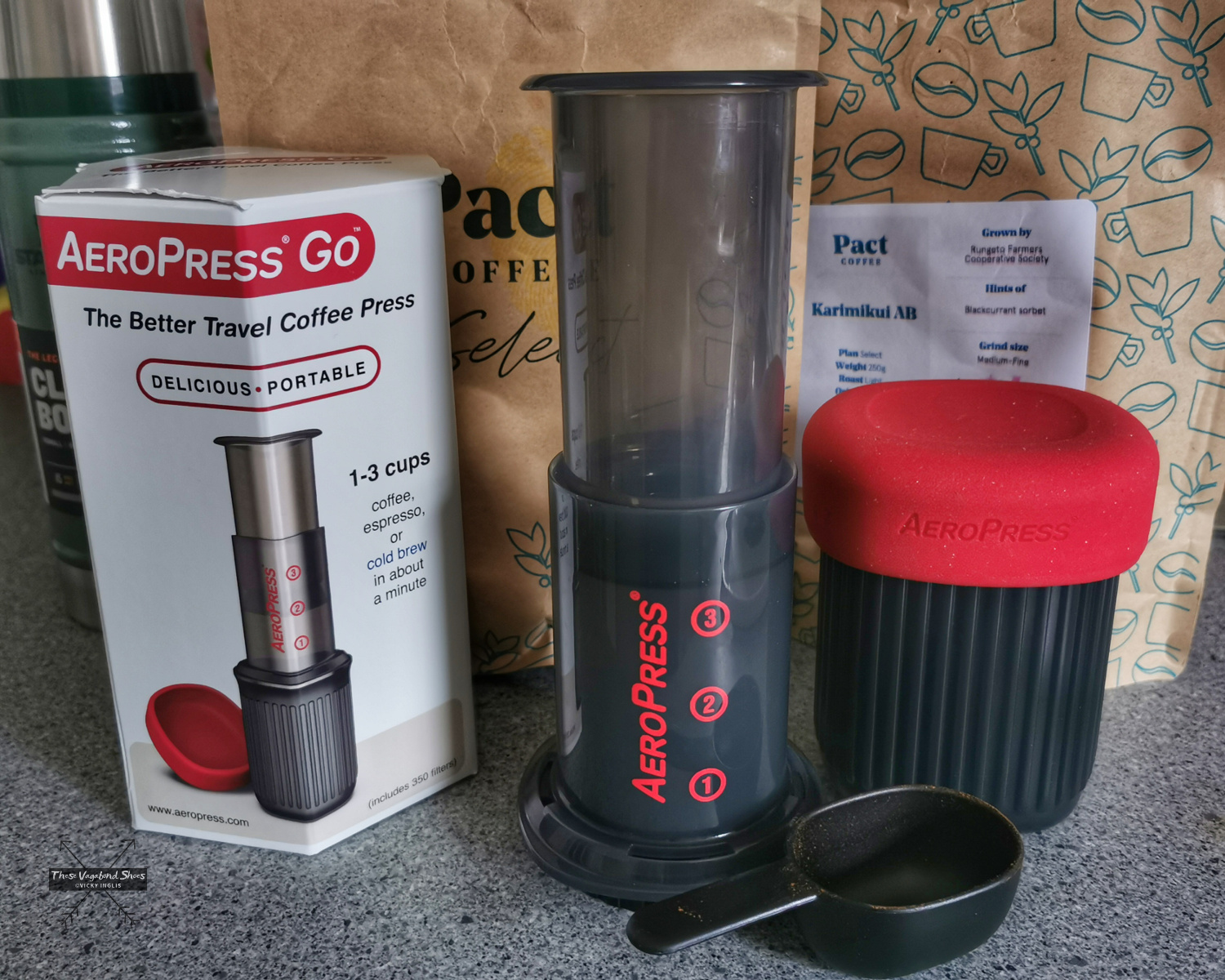
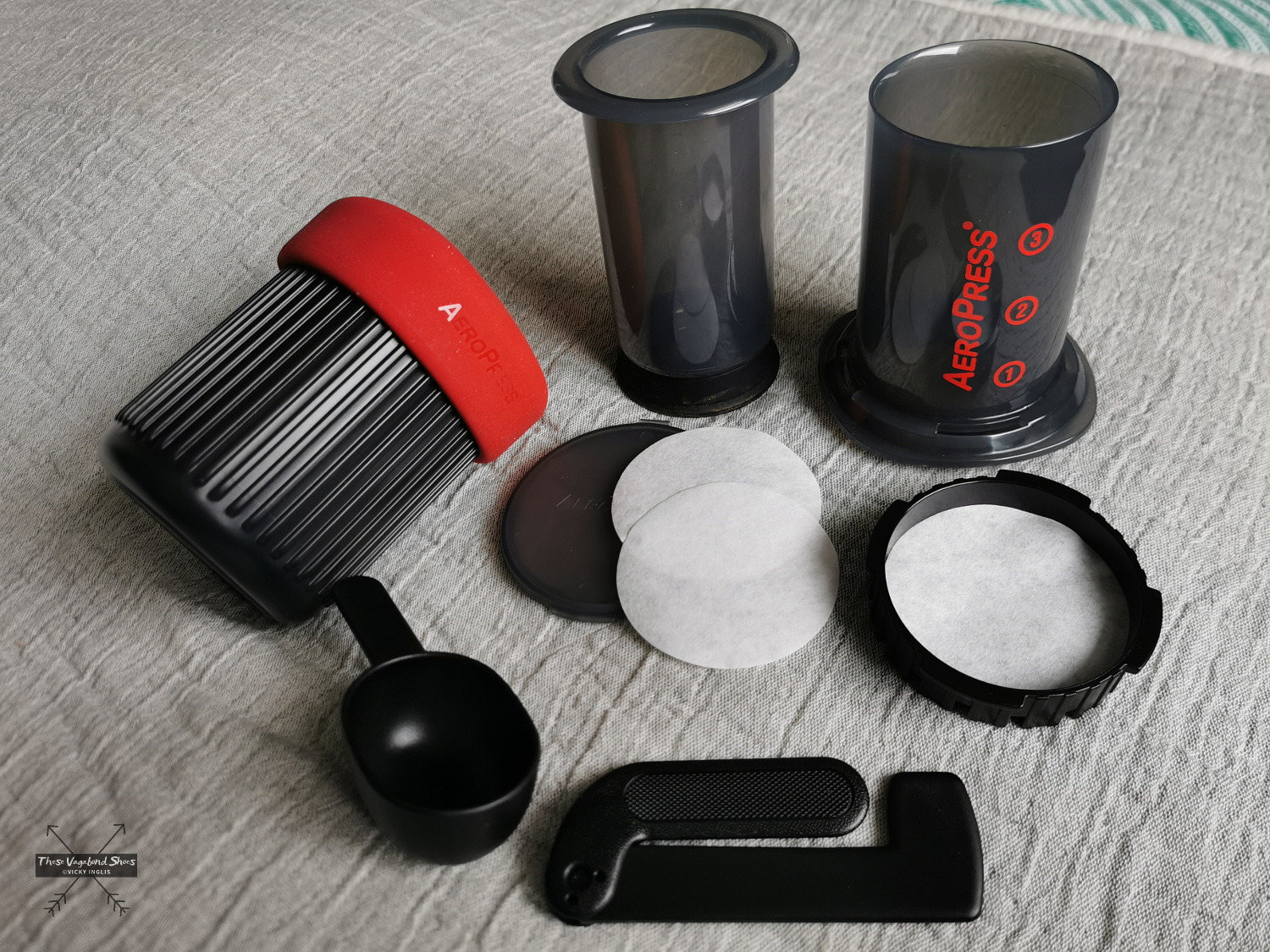
The Aeropress Go is a portable coffee maker designed for outdoor use, expeditions and frequent travel. If you’re familiar with the original Aeropress, the Aeropress Go is a slightly smaller, more streamlined system, which packs into a dual-purpose storage container travel mug.
It can be used to make hot or cold brew coffee, producing around 250ml of espresso-style coffee which can be topped up with water or milk to make a long black or a latte, in less than 30 seconds.
The components are made from lightweight, tough plastic, with a silicone seal on the plunger and silicone lid for the travel mug. The stirrer and scoop have been redesigned to fold into the plunger, and the kit includes a case that can hold around 20 filters.
The complete Aeropress Go system weighs 326g, including the storage container/ mug, scoop and stirrer, and the dimensions when packed inside the mug are a similar size to a Pot Noodle. If you didn’t bother with the mug, the coffee press itself is a similar size to a small can of beer.
The only waste produced by the Aeropress Go is a small “puck” of ground coffee and a used filter. According to the website, the paper filters are both recyclable and compostable and can be rinsed and reused several times.
Field Results
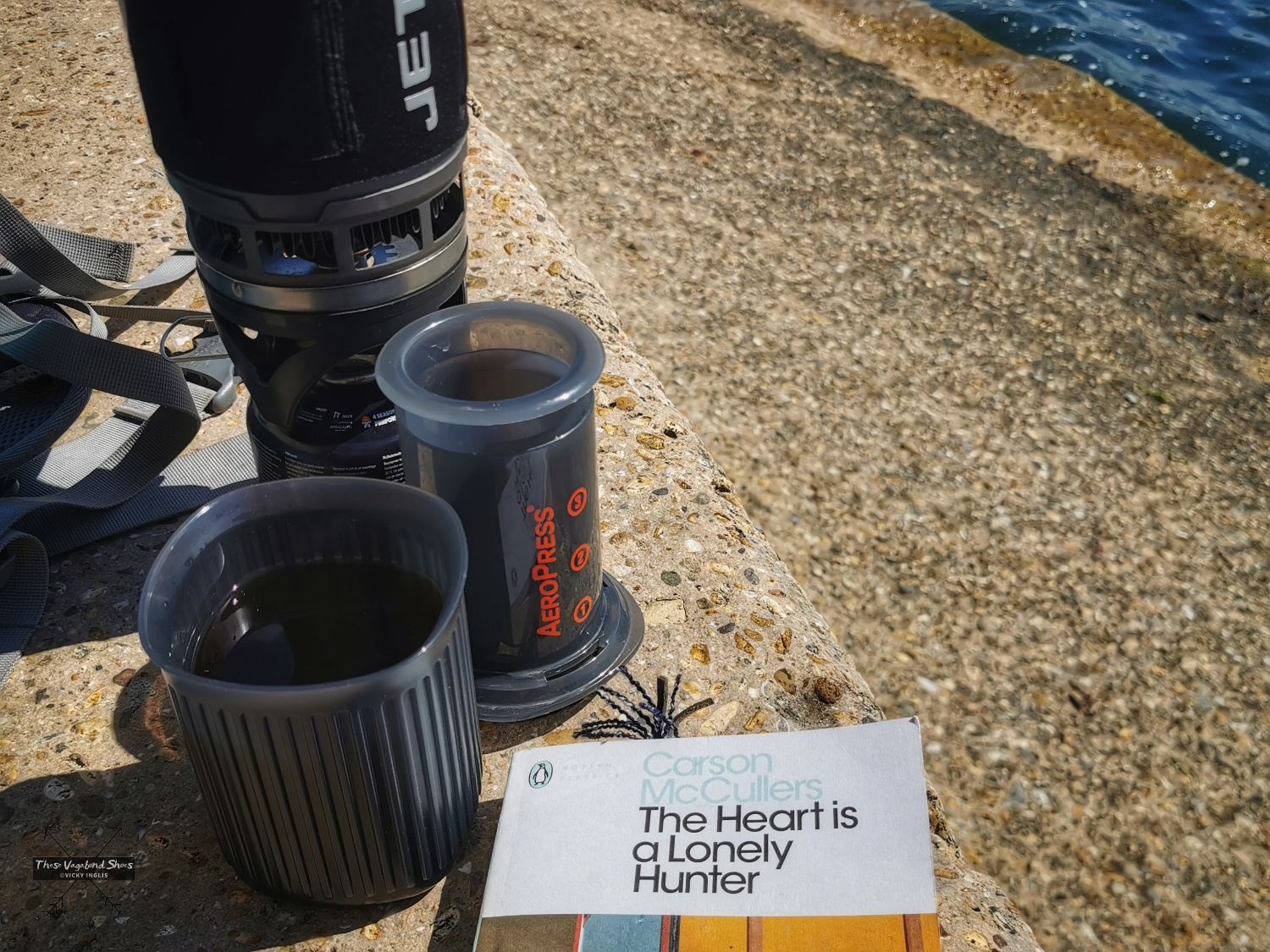
After setting up my Jetboil to heat water, I put a paper filter into the filter cap of the Aeropress Go, twisted it on to the chamber, and added the ground coffee. Once the water was ready, I balanced the chamber on the mug and added the hot water, gave the coffee a stir, and pushed in the plunger to produce a mug of espresso-style coffee. I topped my brew up with more hot water to make a long black coffee, and it was lovely.
There’s a range of techniques for the Aeropress Go to brew coffee to your personal taste, and it’s worth trying a couple, but there are a few things to bear in mind. It isn’t suited to making massive mugs of coffee, if that’s your usual poison, but it does produce small, concentrated cups of consistently good quality, which can be diluted with water or milk to your taste.
The Aeropress Go is really simple to use. There are no complex parts that could break while being used or while rattling around inside my pack, and the materials are pretty robust. I think it’s as close to indestructible as something can be.
Coffee on the coast after swimming in Freshwater Bay, Isle of Wight
The tight fit of the plunger means it’s essentially self-cleaning. This is one of the best features, and the convenience shouldn’t be underestimated. There’s no faffing around to clean it between uses, the used grounds pop out and can be collected in a bag for disposal, and it means there’s no additional water required to wash the coffee maker, compared to something like a Mokka pot.
Worth the money?
The Aeropress Go costs between £28 – £35, depending on the outlet where you find it, slightly more than the original Aeropress system which retails for £24 – £27. A pack of 350 replacement paper filter discs will cost around £6, while a reusable metal mesh filter compatible with either Aeropress will cost around £13.
The Aeropress Go kit actually weighs a little more than the original, by around 100g, but that includes the robust multi-purpose mug/storage container and lid. Weight could be saved by leaving out the coffee scoop and stirrer if you’re already going to be carrying a spoon or spork, and substituting the mug for something more lightweight that doubles as a cooking pot.
Otherwise, your camping coffee maker options could be a coffee press compatible with a stove system like the MSR Windburner or JetBoil Flash, for between £15 and £20 (plus the additional cost of the stove) or Sea to Summit’s collapsible X-brew for pour-over coffee, for around £15.
Conclusion
After seeing how many people used the Aeropress Go while working in South Georgia, I was already sold on getting one for myself. It’s now something I use pretty much every day at home, and has quickly become an essential whenever I travel.
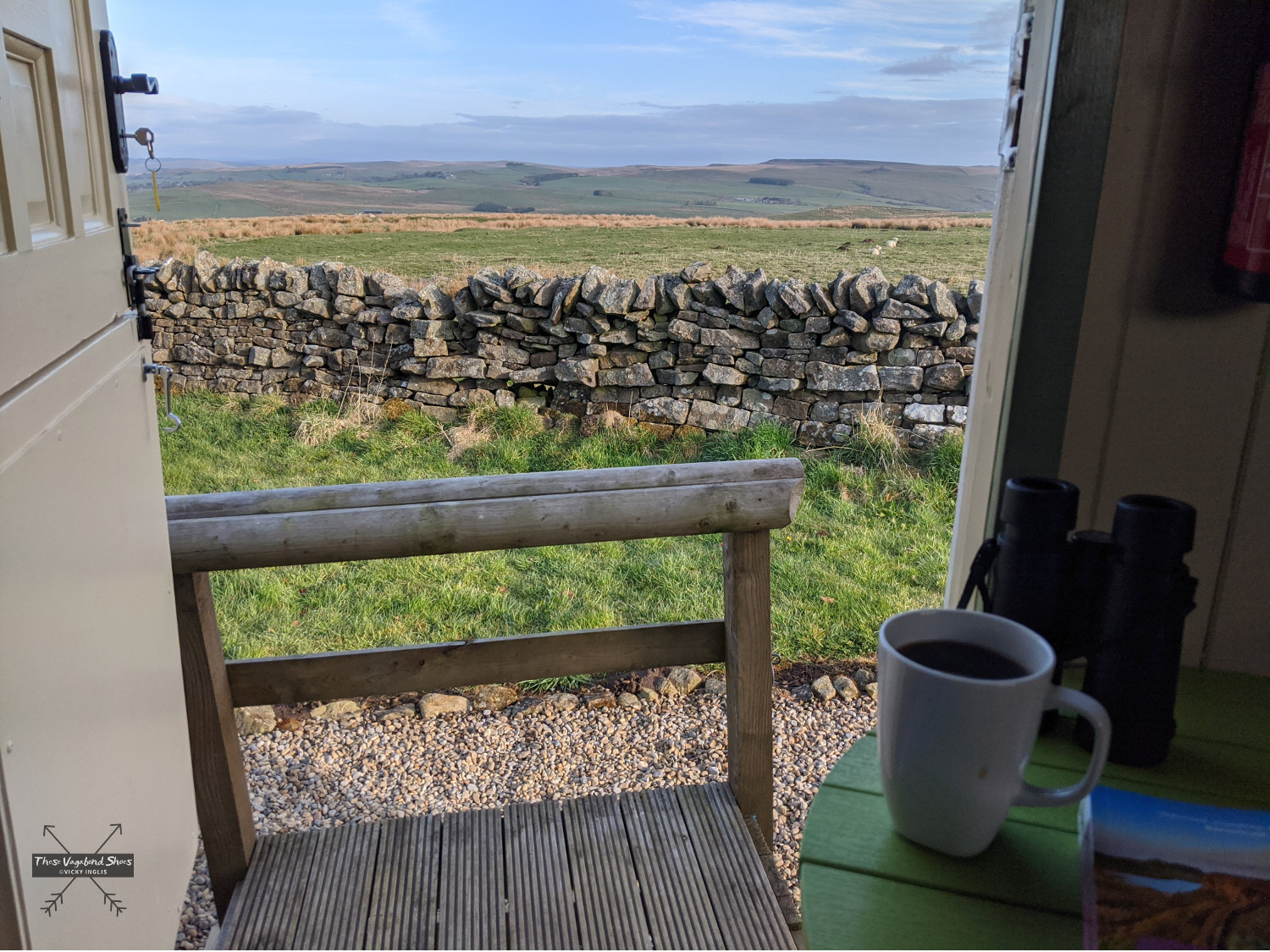
Coffee and birdwatching from a shepherd’s hut in Northumberland National Park
It’s a brilliant bit of equipment. Simple to use and very easy to clean, compact enough for travelling and robust enough to pack into a backpack or kit bag. I think I’ll look at getting a reusable metal filter to replace the paper filters I’ve used so far, further reducing the small volume of ground coffee waste created.
With a change in my work schedule coming up that will include a lot more travel in the future, and a few more backpacking trips planned, I know I’ll get plenty of use from the Aeropress Go, making it well worth the investment.
Disclaimer: I bought the Aeropress Go with the money I had left over after all my bills were paid. This is my honest review after a few months of use.
If you’ve got any questions about making coffee with the Aeropress Go, leave me a message in the comments below.
Why not pin this to your hiking and camping boards for later?
If you’ve really enjoyed my guides and would like to support my ability to continue dedicating time to creating and sharing content, you can buy me a virtual coffee here (or donate as much as you feel). Thank you!
My selection of the most interesting and inspiring books about running adventures around the world.
I’m very much a walker rather than a runner, having decided I quite enjoy keeping my toenails connected to my feet. But a few years ago I dipped my toes into the world of ultra-running (distances beyond a traditional marathon length of 42.2km or 26 miles) and endurance events as I trained alongside my friend Rachel while she prepared to complete the Marathon des Sables, an incredible 251km (134 miles) race over several days in the Sahara Desert.
Very much at the lower end of the epic scale, my greatest ultra running achievement was completing the Isle of Wight coastal path, 113km (70 miles) over two days, with a lot of sunburn and just a mild case of heatstroke to show for it.
So if you’re looking to find the motivation to maintain your New Year’s running resolution, or you’re more than comfortable as an armchair ultra runner, read on to find inspiration for your next running challenge, or enjoy the vicarious exploits of these incredible individuals.
A selection of some of the best books about women’s experiences in the mountains.
In time for International Mountain Day on 11th December, this edition of armchair travel retreads a little bit of old ground. I revisited my selection of books with a mountain setting, picked out a couple of titles, and used them to dive deeper into mountain books by, and about, notable mountain women and their achievements at altitude.
Read my selection of my favourite books with mountain settings, with a couple of new choices thrown into the mix. Or how about a selection of thrilling stories about survival and disaster?
But first, read on and find inspiration for your next mountain adventure or enjoy the vicarious thrills of these incredible women that got high.



 These Vagabond Shoes.